glycoverse
Install all packages
Metapackage for easy installation and loading of the entire glycoverse ecosystem.
The Glycoverse Ecosystem
A cohesive R ecosystem that turns experimental data and glycan structures into clear, reproducible biological insight.
Explore the release API
Choose a task to see how released Glycoverse packages turn complex glyco-omics work into readable R code.
library(glyread)

# Read pGlyco3 + pGlycoQuant output directly into
# a validated glyexp::GlycoproteomicSE container.
exp <- read_pglyco3_pglycoquant(
  "Quant.spectra.list",
  sample_info = "sample_info.csv",
  quant_method = "label-free",
  glycan_type = "N"
)

explibrary(glycoverse)
# Choose suitable preprocessing steps automatically.
clean_exp <- auto_clean(real_experiment)
# The same GlycoproteomicSE moves straight into models.
dea_res <- gly_limma(clean_exp)
pca_res <- gly_pca(clean_exp)
# Turn analysis results into publication-ready views.
plot_volcano(dea_res)
plot_pca(pca_res)library(glyparse)
library(glymotif)
# auto_parse() recognizes common glycan text formats.
glycan <- auto_parse(
"Gal(b1-3)GlcNAc(b1-3)Gal(b1-3)GalNAc(a1-"
)
# Query a curated motif by its biological name.
have_motif(glycan, "O-Glycan core 1")library(ggplot2)
library(glydraw)
library(tibble)
plot_data <- tibble(
glycan = c(
"Gal(b1-3)GalNAc(a1-",
"Gal(b1-3)[GlcNAc(b1-6)]GalNAc(a1-"
),
value = c(1, 2)
)
ggplot(plot_data, aes(glycan, value)) +
geom_col(fill = "grey70") +
geom_glycan(aes(structure = glycan)) +
theme_classic()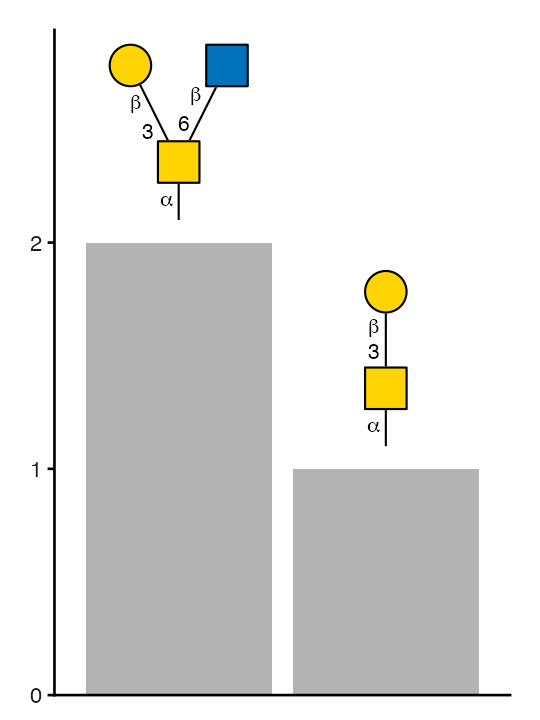
library(glycoverse)
library(glyfun)

exp <- auto_clean(real_experiment)

# Conventional GO enrichment for dysregulated proteins.
dea_res <- gly_limma(exp)
go_res <- enrich_ora_go(dea_res)

# Or ask a glycan-centric question with derived traits.
trait_exp <- derive_traits(exp)
trait_dea <- gly_limma(trait_exp)
glycan_go <- enrich_gc_ora_go(trait_dea)library(glyenzy)
glycan <- paste0(
"Gal(b1-4)GlcNAc(b1-6)",
"[Gal(b1-3)]GalNAc(a1-"
)
# Find enzymes in its biosynthesis...
find_enzyme(glycan)
# ...or predict products made by one enzyme.
apply_enzyme(glycan, "ST3GAL1")Meet the packages
Use the whole ecosystem or compose only the focused tools your analysis needs.
Entrance Packages
Get started with the glycoverse ecosystem in minutes with these two entry points.
Omics Data Analysis
Tackle glycomics data from the first import through visual communication with reproducible, shareable code.
Organize experimental context
Validated GlycomicSE and GlycoproteomicSE containers for modern Bioconductor workflows.

Import diverse formats
Read quantification results from Byonic, StrucGP, pGlyco3, Glyco-Decipher, and MSFragger.
Automatic preprocessing
Preprocess glycomics data with normalization, missing value handling, and batch correction.
Model glycomic signatures
Statistical analysis including differential testing, PCA, clustering, and survival modeling.
Communicate insights
Exploratory visualizations that work directly with GlycomicSE and GlycoproteomicSE data.

Find functional meaning
Gene-set and glycan-centric enrichment for connecting differential glycosylation to biology.
Glycan Structure Analysis
Connect biological meaning to glycan compositions, motifs, and enzyme pathways with interoperable libraries.
Consistent representations
Computational representations of glycan compositions and structures with IUPAC support.
Interpret glycan strings
Parse IUPAC, WURCS, GlycoCT, and Linear Code into glycan structures.
Find recurring motifs
Detect glycan motifs using subgraph isomorphism with curated databases.

Detect glycan patterns
Calculate site-specific derived traits like galactosylation and sialylation.
Trace enzymatic context
Simulate glycosylation biosynthesis and map glycans to glycosyltransferases.
Annotate glycan hierarchy
Deduce glycan compositions and refine structures from mass or generic inputs.
Access glycan database
Query determined glycan structures from GlyTouCan with full linkage information.
Draw SNFG cartoons
Draw beautiful SNFG (Symbol Nomenclature for Glycans) cartoons.